Tuesday, February 19, 2013

Short FIlm: Genre Research

The genre that I would like to use in my short film is Teen Drama because I have a lot of resources to use for a film of this genre and would be able to come up with a lot of great ideas. Being a teenager, I know a lot of drama and common problems for a teenager. Teen Drama is a large genre because teenage years are an age for drama. Here are a some examples of Teen Drama films:


Kids (1995)


Films of this genre often have a protagonist main character with a flaw or issue that makes the character interesting or appealing to the audience. Throughout the story, they face rising actions and overcome their issue during the climax. Common issues in teen dramas are fitting in, drugs, abuse, relationship, teen pregnancy and sex just to name a few. The teenagers are usually stereotyped as nerds, punks, outcasts, jocks or cheerleaders in teen dramas. Also, most of these films have happy endings by solving their issue and or learning a lesson. The acting in these films are usually exaggerated about how teenagers act. They never really are portrayed exactly, but that is the filmic touch on the genre. The settings of these films often vary but common places are schools and big cities. These films do not usually have a complex cinematography and the film really neutral angles. Teenage Drama films usually have a score consisting of music for a teenage crowd. Music that is appealing to teenagers and young adults possibly, which is usually radio played music for the films that can afford to use those songs. The logline for my upcoming short film will be this:

Teenage boy suffering from Obsessive Compulsive Disorder, finds way to cope with his issue.

Wednesday, February 13, 2013

IB Film Oral Assessment - Psycho (1960)


For my IB Oral on a five minute extract from Hitchcock's Psycho (1960), I feel I deserved a 17. I really felt I could have done so much better on this assessment. The parts I struggled on were really finding a deeper, analytical interpretation of my extract. At the time I chose my extract, I did not realize how hard it would be to analyze the deeper meaning behind the scene. I had a lot of trouble trying to find real good information to bring into my oral. It also was really hard to figure out where to start because this is the first time that I have ever done an assessment like this. At some point I choked up and had a lot of pauses to think. After awhile, I felt that I starting just rambling, which is exactly what I did not want to do. I was nervous and probably should have better prepared for this. Next time I will do a better preplan and practice what i'm going to say more than I did.

Tuesday, February 12, 2013

Film Language and Representation

17:55 - 23:15
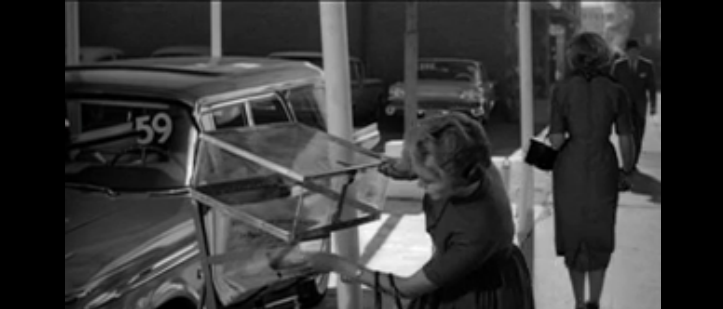
This exterior scene is from when Marion Crane exchanges her car and $700 for a different car at California Charlie’s used car dealership. Marion seems to be panicked, anxious and suspicious to the car salesman. The police officer who had stopped Marion earlier in the film followed her to the car dealership. California Charlie was able to tell right off the back that Marion was up to no good from her quick and panicky body language. Throughout this scene, the camera stays at neutral angle but makes quick cuts time to time when the scene starts to get more intense. The quick cutting is to create suspense among the audience and have them wanting to guess what is next. Suspense is increased when dramatic music is played with the quick cuts, which occurs often in this scene specifically. 


Ex. 1
Ex. 2
The first shot is a wide shot of Marion that cuts to a close up of eyeline matches to a California license plate (Ex. 1) and then to her Arizona license plate in the car dealership. She slowly paces past cars in the lot and looking at the license plates on them. After, she purchases a newspaper (Ex. 2) which is a foreshadow to a later event. California Charlie comes up to her and says, “the first customers of the day are always trouble.”
This dialogue is relevant because of it’s double meaning pertaining to Marion’s situation. As Marion and California Charlie negotiate for the car, the camera cuts quickly back and forth to Marion and the police officer. Because of these quick cuts and the fast paced music, the scene seems more intense and creates a build up. California Charlie is suspicious of her behavior and feels pressured by her to make a quick sale. Throughout the scene he continuously catches her looking at the police officer. From Marion’s dialogue, she seems anxious and nervous. She talks quickly, often stutters and cuts off the car salesman in some cases.


Ex. 3
When she makes her mind up to buy the car, she goes to the restroom to get her $700 in cash out in private. In the bathroom, there is a close up with her hands counting out the money for the car. Within the frame is her hands, her purse, and the newspaper she purchased. These are relevant because later on in the film, she goes into her room privately to hide the rest of her money inside of the newspaper. As Charlie walks her over to the bathroom, he looks at her with a confused look and back at the police officer (Ex. 3). This adds to his curious body language to Charlie about his suspicion for why Marion is acting like this. She comes out of the bathroom and Charlie comes straight forward with her about how she is acting apprehensive about the selling her car. Marion continues to rush him and reassures Charlie that nothing is wrong.

Ex. 4
Together they walk into the garage to finalize the exchange and the police officer pulls into the lot (Ex. 4). The scene intensifies more because the audience wonders what the police officer will do next. After, there is a wide shot of Marion walking out of the garage and notices the police officer with Charlie, the police officer and Marion in the frame. She seems to be spooked and gets in the car quickly and tries to speed off. All of a sudden, a voice yells, “Hey!” The shot pans to left and the police officer nor Charlie can be seen in the frame. The audience likely assumes that it is the police officer, but it happens to be the car mechanic with her bags she left in her other car (Ex. 5). Then Marion drives off, leaving the police officer, California Charlie and the Mechanic in confusion.
Ex. 5

Monday, January 28, 2013

Psycho: Narrative and the Film Extract

The film Psycho was known for it's advanced narrative structure for it's time. Hitchcock was able to really manipulate the thoughts of the audience in this film. The story starts off with a woman, Marion Crane, having an affair with a man in Phoenix, Arizona. The man she is having an affair with is from Los Angeles and carries a lot of money problems. This is a rising action that reveals conflict. The woman goes to work and is put in charge of $40,000 that she planned to steal and to resolve her lover's money issues. While skipping town, she ends up at the Bate's Motel where she meets the real main character, who is a young man named "Norman," that runs the motel. His mother seems to be mentally abusive towards him which makes the audience feel that the man is harmless and the mother as psycho. No pun intended. The woman from Phoenix is murdered in the hotel from who seems to be the mother of Norman. After following Norman for a little while, the story completely 180's and you come to find that his mother never existed and he pretends to be his mother. This film is told from a limited third person storytelling style. Time passes chronologically in this film over about a span of a couple of weeks. The scene where Marion is killed in the shower changes the structure to the film because who the audience thought the main character was, ends up being not as important to the film as they thought. Also when Marion's sister reveals the corpse of Ms. Bates, it alters the structure because it reveals basically the whole mystery behind the storyline. The involvement with the characters Norman and Sam are close because after Marion is murdered, the storyline follows basically only them two. Also they show character developement. For example, Norman's actions because more suspicious and the audience starts to question him. Sam also is revealed to be a more compassionate and caring character. Norman was casted to be a normal looking, slender man to be less obvious about the actual mental sickness of his character. From his appearance, he instantly comes off as a normal character but completely turns into a mentally distressed psychopath. It also was obvious that Norman had affection for Marion when he first met her. A side of jealousy was exemplified by supposively his mother was introduced to show a the abusive side with his mother. This reveals the theme of maternal attachment because his Norman's obedience and loyalty to his mother in a creepy way.

Tuesday, January 22, 2013

Historical and Institutional Influences

 The film Psycho is studied and lectured on today by college English classes in quite prestigious schools in the United States. The colleges are as listed here: Theories of Authorship in the Cinema: Alfred Hitchcock(Bryn Mawr), Hitchcock: Cinema, Gender, Ideology(Tufts), Hitchcock in England and America” (Vanderbilt), The Cinema of Alfred Hitchcock(University of Maryland), and a research seminar on The Hitchcock Canon(Berkeley) (The Canonical Alfred Hitchcock. Lewis. 1.). Because of Psycho, Hitchcock received much feedback and commonly been the subject of seminars and surveys throughout the country from Economic factors had a lot to do with this movie. Studios would not fund or support the film because of it's unmoral and gruesome acts. Studios also thought that the film would cause much drama and controversy among the industry. Eventually, Hitchcock was able to work out a plan with Paramount in order to help with the distribution and exhibition of the film. Paramount received roughly 60% of box office which ended a great deal for the studio. Politics at the time were rough because of post WWII and the Cold War aftermath. Censorship was extremely strict because of the government trying to censor anything that seemed as a Communist act. The violence in this film could have made it seem to be a Communistic act to the public eye and government. Not only Communist acts were a factor in this film, but also the "politics of sexuality." Because of Hitchcock's interest in human emotions, he wanted to learn and master manipulating them. In The Canonical Alfred Hitchcock by Michael J. Lewis, he claims that Hitchcock studied "the human spirit under duress, depicting the wry rebellion of the individual against the crushing and arbitrary forces of modern life, he achieved a monumental art within the narrow conventions of a popular medium." Psycho came down in film history as the first sub-genre of horror called, "slasher" which still exists to this day. The film's infamous shower scene sparked influence among many films such as the Friday the 13th series, the Halloween series, the Scream series and many other films. This film was extremely economically successful. Hitchcock small budget of $806,947 made approximately $50,000,000 in the box office. Roger Ebert of the Chicago Sun-Times says that, "Hitchcock deliberately wanted 'Psycho' to look like a cheap exploitation film." (Chicago Sun-Times. Roger Ebert.)