In Brainair's article, City of God, he elaborates on background knowledge of the film and summarizes the film as whole while explaining the stories of two of the main characters in the film, Knockout Ned and Li'l Ze. In order to show a character's relevance in the film, you need to hear the backstory of another character(s). The story of the Tender Trio create backstory for Li'l Ze while Li'l Ze's story creates backstory for Knockout Ned. Then all three of their stories contribute to Rocket's life story.
The main ideology communicated in the film is based on how violent a character is in the film. From what I have noticed and read from a past article, the characters are place on a social hierarchy from their acts of violence. Li'l Ze stands at the top of the pyramid and is feared by everyone including rival gangs and also the police. While on the other hand, Rocket is at the bottom and not really feared by anyone because he is not violent at all. In a way the ideology communicated in the film can be closely compared to Social Darwinism or "survival of the fittest."
This film has been compared to films such as Pulp Fiction (1994) and Goodfellas (1990), but the author in the Brianair article brings up the conclusion that, "neither of these films actually deal with social problems or issues." I partially disagree because I feel that the ideology that was communicated in Goodfellas was similar to the one I brought up in the 2nd paragraph about City of God. The whole "survival of the fittest" theme goes hand in hand with the Mob/Gangster genre which is why both films can fall under that genre. Historical reference can be direct because this is a true story, but I think it can also relate back to the Vietnam War. The main character Rocket even gave a direct quote saying, "you got used to living in Vietnam," which is implying the favelas as a warzone.
The genre of this film really interests me the most for my research project because I feel there are multiple aspects of the film that create multiple genres. For instance, you can follow Rocket's storyline which gives a "coming of age" genre. Or you can follow Li'l Ze and Knockout Ned's storyline which follows under the Mob/Gangster genre. A lot could be elaborated on if I found films within these genres and narrowed them down to find a film extremely similar to City of God.
Tuesday, April 30, 2013

Monday, April 29, 2013
City of God: Cinematic Portrayal of Violence
In the article, Violence in The City of God: The Fantasy of the Omniscient Spectator by Jennie Carlsten, it discusses the depiction of of violence in the film through it's narrative, cinematography, edit and how it relates to it's "Action/drama" genre. In the beginning of the article, the author gives a brief plot summary followed by some background knowledge of Brazil. Her background knowledge of Brazil is interesting because she goes into detail about the social structure in the favelas where the movie takes place. The multiple storylines intertwine with each other because of the "self-enclosed
community isolated from the outside world." Next, the cinematography and edit is examined and how the favela enviroment affected it. Because of the tight, narrow streets and alleyways, a lot of rapid camera movements and quick cuts were incorporated to exemplify the urgency in the scenes that have the audience lose direction. The author also brought up how the favelas started to turn into a warzone and quoted Rocket from the movie as well from when he said "you got used to living in Vietnam." She discussed the meaning of this line because of it's relevance to the topic of war in the movie. Therefore, comparing the Vietnam war to the gang wars in the favelas. The second section, "Understanding the Violence," brings up a very interesting point. Carlsten says "the characters are defined by their relationship to violence." As I thought more about it, I realized how correct this comment is. Li'l Ze is infamous for how violent he is, while Rocket on the other hand is known for being sensitive. Their reputations exemplify both of their spots on the social structure in the City of God. She generally characterizes everyone in the film as "under-developed." I think this also is correct because of the isolation of the favelas which was brought up earlier in the article. Everyone from the favelas in under-devloped in the sense that very few of them have seen what is on the outside of the favela and also have very low levels of education. Although there seems to be like a lot of violence in the film, the violence was very controlled in a way. Carlsten brings up the censorship on violence through the cinematography. She claims that, "The use of long shots and off-screen space prevents the audience from seeing much of the violence, and deprives the viewer of the catharsis that may be produced by seeing a violent act carried to its conclusion." The type of shots and angles that are used help the audience feel the right amount of fear, suspense, etc... for the act of violence on screen. For example, when Knockout Ned was witnessing his girlfriend getting raped, it was an over the shoulder shot from Ned's shoulder which makes the audience assume what's going on. In Violence in The City of God: The Fantasy of the Omniscient Spectator by Jennie Carlsten, violence is shown through it's narrative, cinematography, and edit.
Tuesday, February 19, 2013
Short FIlm: Genre Research
The genre that I would like to use in my short film is Teen Drama because I have a lot of resources to use for a film of this genre and would be able to come up with a lot of great ideas. Being a teenager, I know a lot of drama and common problems for a teenager. Teen Drama is a large genre because teenage years are an age for drama. Here are a some examples of Teen Drama films:

Kids (1995)


Films of this genre often have a protagonist main character with a flaw or issue that makes the character interesting or appealing to the audience. Throughout the story, they face rising actions and overcome their issue during the climax. Common issues in teen dramas are fitting in, drugs, abuse, relationship, teen pregnancy and sex just to name a few. The teenagers are usually stereotyped as nerds, punks, outcasts, jocks or cheerleaders in teen dramas. Also, most of these films have happy endings by solving their issue and or learning a lesson. The acting in these films are usually exaggerated about how teenagers act. They never really are portrayed exactly, but that is the filmic touch on the genre. The settings of these films often vary but common places are schools and big cities. These films do not usually have a complex cinematography and the film really neutral angles. Teenage Drama films usually have a score consisting of music for a teenage crowd. Music that is appealing to teenagers and young adults possibly, which is usually radio played music for the films that can afford to use those songs. The logline for my upcoming short film will be this:
Teenage boy suffering from Obsessive Compulsive Disorder, finds way to cope with his issue.
Wednesday, February 13, 2013
IB Film Oral Assessment - Psycho (1960)
For my IB Oral on a five minute extract from Hitchcock's Psycho (1960), I feel I deserved a 17. I really felt I could have done so much better on this assessment. The parts I struggled on were really finding a deeper, analytical interpretation of my extract. At the time I chose my extract, I did not realize how hard it would be to analyze the deeper meaning behind the scene. I had a lot of trouble trying to find real good information to bring into my oral. It also was really hard to figure out where to start because this is the first time that I have ever done an assessment like this. At some point I choked up and had a lot of pauses to think. After awhile, I felt that I starting just rambling, which is exactly what I did not want to do. I was nervous and probably should have better prepared for this. Next time I will do a better preplan and practice what i'm going to say more than I did.
Tuesday, February 12, 2013
Film Language and Representation
17:55 - 23:15
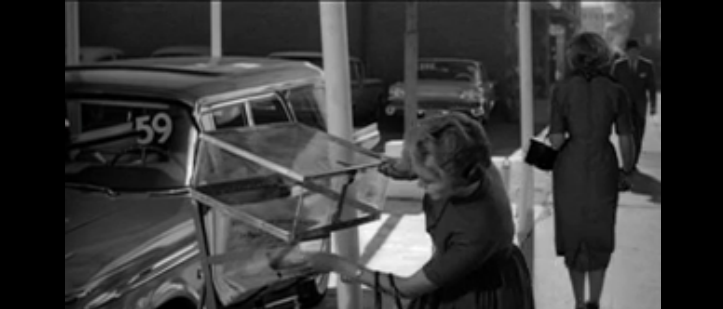
This exterior scene is from when Marion Crane exchanges her car and $700 for a different car at California Charlie’s used car dealership. Marion seems to be panicked, anxious and suspicious to the car salesman. The police officer who had stopped Marion earlier in the film followed her to the car dealership. California Charlie was able to tell right off the back that Marion was up to no good from her quick and panicky body language. Throughout this scene, the camera stays at neutral angle but makes quick cuts time to time when the scene starts to get more intense. The quick cutting is to create suspense among the audience and have them wanting to guess what is next. Suspense is increased when dramatic music is played with the quick cuts, which occurs often in this scene specifically.
The first shot is a wide shot of Marion that cuts to a close up of eyeline matches to a California license plate (Ex. 1) and then to her Arizona license plate in the car dealership. She slowly paces past cars in the lot and looking at the license plates on them. After, she purchases a newspaper (Ex. 2) which is a foreshadow to a later event. California Charlie comes up to her and says, “the first customers of the day are always trouble.”
This exterior scene is from when Marion Crane exchanges her car and $700 for a different car at California Charlie’s used car dealership. Marion seems to be panicked, anxious and suspicious to the car salesman. The police officer who had stopped Marion earlier in the film followed her to the car dealership. California Charlie was able to tell right off the back that Marion was up to no good from her quick and panicky body language. Throughout this scene, the camera stays at neutral angle but makes quick cuts time to time when the scene starts to get more intense. The quick cutting is to create suspense among the audience and have them wanting to guess what is next. Suspense is increased when dramatic music is played with the quick cuts, which occurs often in this scene specifically.
 |
| Ex. 1 |
 |
| Ex. 2 |
This dialogue is relevant because of it’s double meaning pertaining to Marion’s situation. As Marion and California Charlie negotiate for the car, the camera cuts quickly back and forth to Marion and the police officer. Because of these quick cuts and the fast paced music, the scene seems more intense and creates a build up. California Charlie is suspicious of her behavior and feels pressured by her to make a quick sale. Throughout the scene he continuously catches her looking at the police officer. From Marion’s dialogue, she seems anxious and nervous. She talks quickly, often stutters and cuts off the car salesman in some cases.
When she makes her mind up to buy the car, she goes to the restroom to get her $700 in cash out in private. In the bathroom, there is a close up with her hands counting out the money for the car. Within the frame is her hands, her purse, and the newspaper she purchased. These are relevant because later on in the film, she goes into her room privately to hide the rest of her money inside of the newspaper. As Charlie walks her over to the bathroom, he looks at her with a confused look and back at the police officer (Ex. 3). This adds to his curious body language to Charlie about his suspicion for why Marion is acting like this. She comes out of the bathroom and Charlie comes straight forward with her about how she is acting apprehensive about the selling her car. Marion continues to rush him and reassures Charlie that nothing is wrong.
Together they walk into the garage to finalize the exchange and the police officer pulls into the lot (Ex. 4). The scene intensifies more because the audience wonders what the police officer will do next. After, there is a wide shot of Marion walking out of the garage and notices the police officer with Charlie, the police officer and Marion in the frame. She seems to be spooked and gets in the car quickly and tries to speed off. All of a sudden, a voice yells, “Hey!” The shot pans to left and the police officer nor Charlie can be seen in the frame. The audience likely assumes that it is the police officer, but it happens to be the car mechanic with her bags she left in her other car (Ex. 5). Then Marion drives off, leaving the police officer, California Charlie and the Mechanic in confusion.
 |
| Ex. 3 |
 |
| Ex. 4 |
 |
| Ex. 5 |
Subscribe to:
Posts (Atom)